

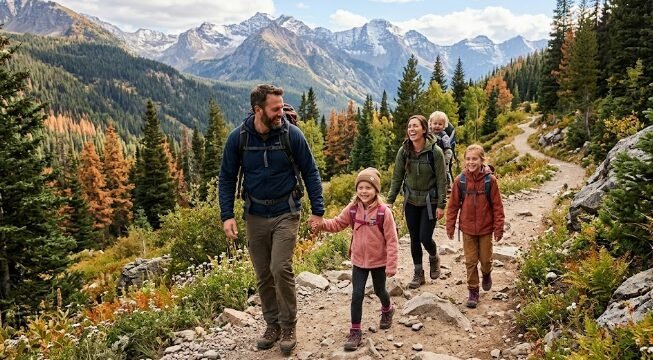
There’s a specific kind of magic in watching a five-year-old’s face when a geyser erupts forty feet into the air, or seeing a preschooler solemnly raise their right hand to recite the Junior Ranger pledge before a park ranger pins a badge to their shirt. These moments aren’t reserved for experienced backpacking families — America’s national parks are genuinely some of the most accessible, rewarding destinations available for families with kids of nearly any age, provided you pick the right park and plan around a few practical realities.
This guide covers which national parks work best for families specifically, the stroller-friendly trails and Junior Ranger programs worth knowing about, and the practical planning details — timing, permits, realistic expectations — that separate a smooth family trip from a stressful one. We’ve covered several of these parks in much greater depth elsewhere on the site, so we’ll link out to our full guides throughout.
Table of Contents
What Makes a National Park Family-Friendly
Before ranking specific parks, it helps to understand what actually separates a great family national park experience from a stressful one. Three factors matter most: stroller and young-child accessibility (paved or hard-packed trails with gentle grades), realistic drive times and proximity to amenities (bathrooms, food options, and manageable distances between attractions), and structured programming like Junior Ranger badges, which give kids a genuine sense of accomplishment and engagement beyond just looking at scenery.
Every one of the major national parks offers a free Junior Ranger program, and children under 15 typically enter parks at no charge regardless of the standard vehicle entrance fee, making national parks a genuinely strong value for family travel compared to many other vacation types.
Best National Parks for Families, Ranked
Yellowstone National Park — Best for Wildlife and Wonder
Yellowstone tends to be the park kids already know before you even mention the trip — geysers, bison, and that distinctive sulfur smell they won’t stop pointing out. The boardwalks around Old Faithful and Midway Geyser Basin are stroller-friendly and mostly flat, meaning you can push a stroller right up to bubbling hot springs and steaming geysers without difficulty. For 2026 specifically, Yellowstone’s Junior Ranger program added two new extensions worth knowing about: Junior Ranger Anglers and Junior Ranger Night Sky Explorers, both strong options if your kid already has an interest in fishing or stargazing. Our complete Yellowstone National Park guide covers entrance fees, timing, and full itinerary planning in much greater depth.
Family tip: stay inside the park if budget allows — the drive between gateway towns and the geyser basins becomes genuinely difficult with kids needing frequent bathroom stops, and in-park lodging eliminates that friction entirely.
Zion National Park — Best for Dramatic Scenery Without Extreme Hiking
Zion’s towering red cliffs and easy-access canyon floor make it a standout choice for families wanting dramatic scenery without committing to strenuous hiking. The park’s required shuttle system (running March through November) is, somewhat counterintuitively, a genuine family travel advantage — no fighting for parking, no navigation stress, just hopping on and off at trailheads and viewpoints. The Riverside Walk, a paved 2-mile trail along the Virgin River, is fully stroller-friendly, while Weeping Rock offers a short, easy 0.4-mile walk to a natural spring-fed alcove that consistently delights younger kids. Our full Zion National Park guide covers the shuttle system, permits, and seasonal planning in detail.
Grand Canyon National Park — Best Overall for All Ages
The Grand Canyon’s sheer scale impresses kids and adults alike, and the South Rim specifically offers family-friendly amenities, educational exhibits, and genuinely easy trails suitable for younger children. One important caution worth repeating for any family planning a visit: there’s no fence around most of the canyon rim, so close supervision near any unmarked edge is essential rather than optional. Our complete Grand Canyon National Park guide covers South Rim versus North Rim planning, current entrance fees, and safety considerations specific to traveling with kids.
Yosemite National Park — Best for Waterfalls and Sequoias
Yosemite with toddlers works beautifully if you stick primarily to the valley floor, where paved paths connect meadows, waterfalls, and scenic viewpoints without requiring any steep climbing. Spring and early summer offer the strongest waterfall flow, making this the ideal window for a family visit focused on the park’s signature cascades. Given 2026’s significant change to Yosemite’s entry system, our complete Yosemite National Park guide is worth reading closely before finalizing family travel dates this year specifically, since crowd management has shifted meaningfully from recent seasons.
Great Smoky Mountains National Park — Best Free, Easy-Access Option
As the most-visited national park in the entire country, Great Smoky Mountains earns that title partly through genuine family accessibility — free admission (one of the only major parks with no entrance fee at all), easy access from major East Coast cities, and miles of paved, stroller-friendly trails. The Cades Cove wildlife loop drive lets kids spot deer, black bears, and wild turkeys without leaving the car, a strong option for younger children or anyone needing a lower-energy day. Arriving at Cades Cove by 8 a.m. meaningfully improves the experience by beating the worst of the day’s traffic.
Acadia National Park — Best for Coastal Variety
Acadia’s 45 miles of car-free, crushed-gravel carriage roads were practically designed for strollers and toddler bikes, while the Maine coastline adds tide pooling, sandy beaches, and ocean breezes that inland parks simply can’t offer. Tide pooling at Bar Island during low tide is a consistent family favorite, though checking tide charts in advance is genuinely necessary rather than optional for this specific activity.
Arches National Park — Best for Rock Scrambling
With over 2,000 stone arches across nearly 120 square miles, Arches offers short trails and genuine rock-scrambling opportunities that kids of nearly all ages enjoy. The Sand Dune Arch trail, just 0.4 miles, features soft sand that functions like a giant natural sandbox for toddlers, while the Balanced Rock trail offers a fully stroller-friendly 0.3-mile paved path.
Junior Ranger Programs Worth Prioritizing
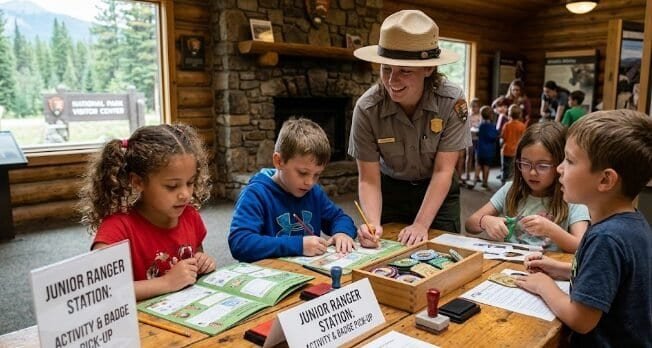
The Junior Ranger program deserves special mention as one of the best free resources available to families at nearly every national park. Kids complete age-appropriate activities in a booklet (typically $3-5 at visitor centers), then recite a pledge to a ranger in exchange for an official badge. Beyond the badge itself, the program genuinely improves engagement — kids who might otherwise tune out during a scenic drive often become invested once they’re working toward a specific goal.
Yellowstone’s 2026 additions (Junior Ranger Anglers and Night Sky Explorers) reflect a broader trend of parks expanding these programs beyond the standard nature-focused booklet, worth checking for at any park you’re visiting since program offerings vary considerably and update regularly.
Planning Around Permits and Reservations in 2026
Several popular family-friendly parks have specific 2026 entry requirements worth knowing well before your trip:
Rocky Mountain National Park requires timed-entry permits from May 22 through October 12, between 9 a.m. and 2 p.m., with a separate, stricter Bear Lake Road permit required from 5 a.m. to 6 p.m. through October 18. These are booked through Recreation.gov for a small fee and release in monthly batches — this is genuinely not a park to “wing it” at during peak season.
Glacier National Park, by contrast, suspended its vehicle reservation requirement entirely for 2026, a major shift from the 2021-2025 seasons. Families can now drive the full Going-to-the-Sun Road without booking ahead, though a new Logan Pass parking limit (three hours, starting July 1, 2026) means arriving early remains important for families hoping to hike near that specific area.
Yosemite National Park similarly paused its reservation system for 2026, though as covered in our dedicated guide, this has led to genuinely heavier crowding than recent reservation-managed seasons — families should plan around earlier arrivals and more flexibility than in past years.
Best Time of Year for Family National Park Trips
Spring (April-May) and fall (September-October) consistently rank as the strongest windows for family national park trips, offering milder temperatures and noticeably thinner crowds than peak summer, when school schedules push most families into the same narrow June-August window regardless of weather considerations.
Summer (June-August), while the most crowded season virtually everywhere, remains the only realistic option for families constrained by school calendars — planning around early morning activities and treating midday as downtime (pool time, indoor visitor center exhibits, or simply rest) helps manage both heat and crowds during this window.
Winter works well for specific parks like Death Valley, which becomes genuinely inaccessible during summer’s extreme heat but offers comfortable conditions and excellent stargazing from November through March.
Budgeting for a Family National Park Trip
The $80 America the Beautiful Annual Pass covers entrance fees for one vehicle at every national park for a full year, paying for itself after just two park visits given standard $35 per-park entrance fees — a strong value for any family planning more than one park trip within twelve months. Active-duty military families, fourth-grade students, and families with a member who has a permanent disability all qualify for free or discounted pass options worth checking before paying full price.
Lodging inside parks tends to cost more than gateway-town alternatives but saves meaningfully on drive time and the logistics challenges of traveling with young kids — a trade-off worth making for families specifically, even if budget-conscious solo travelers might lean toward outside lodging instead.
Common Mistakes Families Make at National Parks
Underestimating how much slower everything moves with kids. A hike that takes an adult an hour might take a family with young children twice as long, and itineraries built around adult-pace expectations routinely create stress that’s entirely avoidable with more realistic time budgeting.
Not checking specific park permit requirements for 2026. As covered above, requirements vary dramatically by park this year — Rocky Mountain requires strict timed entry while Glacier and Yosemite have dropped reservations entirely, and assuming any one park’s rules apply elsewhere is a common, avoidable mistake.
Packing for adult hiking conditions rather than family pace. More frequent breaks, more snacks and water than an adult-only trip would require, and genuine flexibility to turn back early all matter more with kids along.
Skipping the Junior Ranger program because it seems like “just for little kids.” Many parks offer ranger programs scaled for older kids and even teens, and the engagement value extends well beyond the youngest age range most parents assume it’s designed for.
What to Pack for a Family National Park Trip
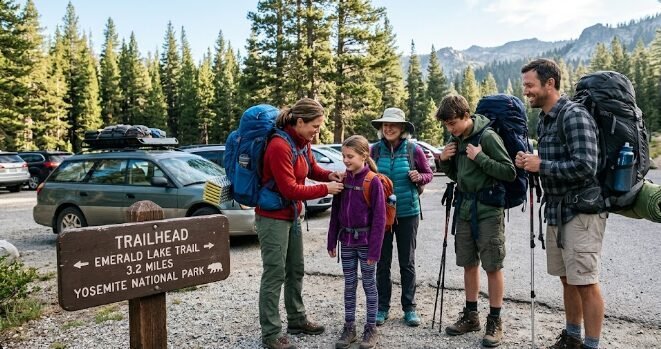
A well-stocked daypack per adult, including more water and snacks than feels strictly necessary — kids dehydrate and get hungry faster than adults, and running short on either mid-hike turns a fun outing into a difficult one quickly.
Layers regardless of season or destination park. Many of the parks covered above sit at meaningful elevation, where temperatures shift dramatically between morning and afternoon even in summer, and a cold, uncomfortable kid rarely wants to continue exploring.
A reliable child carrier for younger kids if your itinerary includes any trail beyond fully flat, paved paths — even strong toddler walkers tire faster than parents expect, and having a backup carrying option prevents an early, frustrated trip back to the car.
Sun protection appropriate for the specific park’s exposure level. Desert parks like Arches and high-elevation trails at Rocky Mountain or Yosemite see significantly more intense sun exposure than forested parks like Great Smoky Mountains, worth adjusting your sunscreen and hat strategy accordingly.
A printed or downloaded Junior Ranger booklet if available in advance, since some parks allow younger kids to start working through activities in the car on the drive in, rather than needing to complete everything in a single visitor center stop.
Safety Considerations for Family National Park Visits
Wildlife distance rules apply just as much to families as solo travelers, and arguably matter more given kids’ natural curiosity and shorter attention spans around safety instructions. Reinforce appropriate distances before arriving, not as you’re standing next to a bison or elk.
Water safety deserves specific attention at parks with significant water features — river crossings at Zion’s Narrows, waterfalls at Yosemite and Yellowstone, and coastal areas at Acadia all carry real risks that differ meaningfully from a backyard pool or even a calm lake, and constant supervision near any moving water is essential.
Heat safety matters enormously at desert parks like Arches and Death Valley, where summer temperatures can become dangerous quickly, particularly for young children whose bodies regulate temperature less efficiently than adults. Many family travel guides specifically recommend avoiding desert parks entirely during peak summer months in favor of spring, fall, or winter visits instead.
Altitude can affect kids differently than adults at higher-elevation parks like Rocky Mountain and parts of Yellowstone and Yosemite, sometimes causing headaches or unusual fatigue that parents might initially mistake for general crankiness rather than altitude-related symptoms — building in extra rest and hydration during the first day or two at elevation helps most families acclimate without significant issues.
Frequently Asked Questions
What’s the best age to take kids to national parks? Children ages 5-12 tend to get the most out of national park visits, since they can fully participate in Junior Ranger programs and handle moderate hiking distances. That said, many parks offer stroller-friendly boardwalks and scenic drives that work well even for toddlers, and teens often appreciate the more adventurous side of park visits — longer hikes, rock scrambling, and water activities.
Which national park is best for a first family trip? Great Smoky Mountains National Park is frequently recommended as a strong starting point given its free admission, proximity to East Coast population centers, and extensive paved trail network, though Yellowstone and Zion both offer excellent first-trip experiences for families willing to travel further west.
How much does a family national park trip typically cost? Costs vary enormously by trip length and lodging choices, but the America the Beautiful Annual Pass at $80 covers entrance fees regardless of how many parks you visit within a year, and many of the best family activities — junior ranger programs, scenic drives, boardwalk trails — cost nothing beyond the entrance fee itself.
Are pets allowed on national park trails? Generally no — most parks restrict pets to developed areas like campgrounds, parking lots, and paved roads, with pets prohibited on trails, in visitor centers, and in wilderness areas. A small number of parks, including Acadia and the Grand Canyon’s North Rim, offer some pet-friendly trail exceptions, but checking each specific park’s policy on NPS.gov before traveling with a pet remains essential.
Do national parks have good food and bathroom options for families? This varies considerably by park and specific location within it — major visitor centers and in-park lodges typically offer reasonable food and restroom facilities, though pricing tends to run higher than outside the park, while more remote trailheads may only have basic pit toilets or no facilities at all, worth factoring into planning for families with young children.
Final Thoughts
National parks remain one of the strongest values in American family travel — genuinely awe-inspiring scenery, free educational programming through the Junior Ranger system, and enough variety across the system that almost any family’s interests and energy levels can find a strong match. The key planning differences in 2026 specifically come down to permit requirements, which vary dramatically by park this year, from Rocky Mountain’s strict timed entry to Glacier and Yosemite’s newly reservation-free (but more crowded) access.
Whichever park you choose, the families who report the best experiences consistently share the same approach: realistic pacing that accounts for kids’ slower rhythm, genuine flexibility when plans need to change, and full participation in programs like Junior Ranger that turn a scenic drive into something kids actively remember years later.