

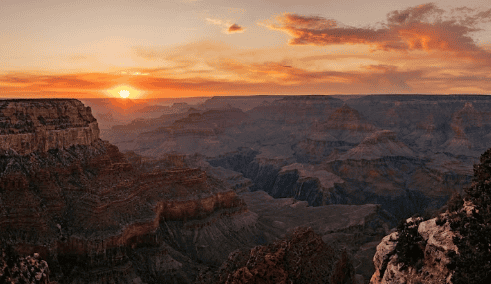
No photograph prepares you for the actual scale of the Grand Canyon. You can see a thousand pictures, watch every documentary, and still walk up to the South Rim for the first time and just stop — not because it’s beautiful, though it is, but because your brain genuinely struggles to process something that big. A mile deep, up to 18 miles wide, and 277 river miles long, carved by the Colorado River over roughly six million years. Numbers like that don’t really mean anything until you’re standing at the edge of one.
This guide covers what you actually need to know to plan a real visit — not just the postcard version. Entrance fees, which rim makes sense for your trip, safety information that genuinely matters in this particular park, and the kind of practical detail that turns a rushed day trip into something you’ll actually remember well. If you’re combining this with other parks in the region, our Route 66 road trip guide covers the classic detour from Arizona’s stretch of the Mother Road, and our Yellowstone National Park guide is useful if you’re building a bigger Western national parks itinerary.
Table of Contents
The Grand Canyon sits in northern Arizona and is divided into distinct areas that don’t connect to each other by any short drive — a detail that surprises a lot of first-time visitors and genuinely changes how you should plan your trip.
Understanding the Different Rims (This Decision Matters More Than You’d Think)
This is the single most important planning decision for a Grand Canyon trip, and it’s the one most first-time visitors get wrong simply because they don’t realize how separated these areas really are.
South Rim is the Grand Canyon almost everyone pictures when they think of this park. It’s open year-round, has the most infrastructure — visitor centers, lodges, shuttle buses, restaurants — and accounts for the vast majority of the park’s roughly 4.9 million annual visitors. If you’re only visiting once, or if your trip is shorter than three days, this is almost certainly where you should go.
North Rim sits at higher elevation, feels noticeably more remote and less crowded, and offers a genuinely different perspective on the canyon. The catch: it’s seasonal, typically open from mid-May to mid-October, and the drive between the two rims is substantial — roughly five hours and 220 miles by car, even though they’re only about 10 miles apart as the crow flies across the canyon itself. For 2026 specifically, the North Rim’s seasonal reopening is tentatively planned for May 15, though this remains dependent on weather, trail conditions, and the completion of hazard mitigation work — worth checking the official NPS Grand Canyon alerts page close to your travel dates, since recent fire-related damage has affected access to certain areas in past seasons.
Grand Canyon West (home of the famous glass Skywalk) is a separate operation entirely, run by the Hualapai Tribe rather than the National Park Service, located roughly 120 miles from the South Rim. It’s the closest canyon viewpoint to Las Vegas, making it popular with visitors doing a Vegas day trip, but it offers a meaningfully different experience than the National Park sections — less hiking infrastructure, more of a single-attraction visit centered on the Skywalk itself. Tickets and packages here are booked separately through the Hualapai Tribe’s own tourism operation rather than through Recreation.gov or standard NPS channels, and pricing tends to run higher than standard national park entrance given the added Skywalk experience and the longer, more remote access road required to reach it.
For most first-time visitors with limited time, the South Rim is the right call. It has the iconic viewpoints, the most reliable access, and the infrastructure to support a comfortable trip without extensive advance logistics.
Entrance Fees and Passes for 2026
A standard vehicle entrance pass runs $35 and is valid for seven consecutive days, covering access to both the South Rim and North Rim (when the North Rim is open) within that window. Pedestrians and cyclists pay $20 per person, and motorcycles run $30. These passes can be purchased at entrance stations, online in advance through the National Park Service, or at the Grand Canyon Visitor Center IMAX in Tusayan just outside the South Rim entrance — buying ahead is genuinely worth doing during peak season, since it reduces wait time at the gate considerably.
As with several other major Western parks, Grand Canyon now charges a $100 nonresident surcharge for non-U.S. residents aged 16 and older, layered on top of the standard fee, effective as of 2026. If you’re traveling with international friends or family, or if you’re a non-U.S. resident visiting more than one park this year, the Non-Resident Annual Pass at $250 covers entrance and standard day-use fees across all national parks for a full year — worth the math if you’re hitting three or more parks, or traveling with a larger group.
For U.S. residents planning multiple park visits in 2026, the America the Beautiful Annual Pass at $80 remains the better value, just as it does at Yellowstone and most other major parks.
One detail worth flagging clearly: no reservations or timed entry tickets are required to enter Grand Canyon National Park at any of its three main entrances — South, North, or Desert View. This differs from some other heavily visited parks that have moved to reservation systems, so you can show up directly, though during peak hours expect a wait.
Practical timing tip: during spring break and peak summer, plan to arrive before 9:30 a.m. or after 4 p.m. Lines at the South Entrance during midday hours in this window can run up to two hours.
When to Visit: The Real Breakdown
Spring (April-May) Widely considered one of the two best windows of the year. South Rim daytime temperatures sit in a comfortable 60-65°F range, crowds haven’t hit full summer peak (the main exception being the first two weeks of April, which overlap with school spring break and bring a genuine crowd surge), and wildflowers are blooming across the rim trails. The North Rim typically reopens mid-May, so late-spring visits are your earliest opportunity to access that side of the park.
Summer (June-August) This is peak season, and it comes with serious trade-offs. Both crowds and heat hit their annual maximum. Afternoon monsoon storms roll through most days between 11 a.m. and 6 p.m. during the core of summer, bringing dramatic lightning and occasional temporary trail closures. The inner canyon becomes genuinely dangerous during this period — more on that in the safety section below. If summer is your only option due to school schedules, plan rim activities for early morning and evening, and treat midday as downtime rather than hiking time.
Fall (September-October) The second of the two best windows, and arguably the better-kept secret of the year. October specifically offers excellent temperatures for inner-canyon hiking (lower than summer’s dangerous extremes) alongside thinning crowds and the North Rim’s fall color display, concentrated in pockets of aspen trees that contrast sharply with the canyon’s evergreen-dominated landscape elsewhere. September and October can still get busy on weekends, particularly around the Grand Canyon Trail Half Marathon and various fall festivals, so book lodging ahead if your dates land near a known event.
Winter (November-March) The quietest season by a wide margin, and genuinely worth considering if solitude matters more to you than convenience. The South Rim stays open year-round, and a dusting of snow against the canyon’s red and orange rock layers creates some of the most striking photography conditions of the entire year. The North Rim, however, closes completely in winter — Highway 67 typically shuts down with the first major snowstorm, usually late November or early December, and doesn’t reopen until the following May. South Rim trails can get icy, so traction devices for footwear are worth packing if you’re planning any rim-trail hiking in winter.
Critical Safety Information (Please Actually Read This Section)
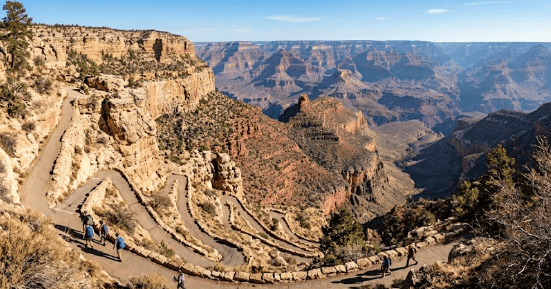
This isn’t standard travel-blog boilerplate. The Grand Canyon’s inner canyon genuinely kills people most years, almost entirely through preventable heat-related incidents, and the temperature data explains exactly why.
While the South Rim sits at a relatively mild 60-65°F during peak shoulder season, the inner canyon is a completely different climate zone. Phantom Ranch, at the bottom of the canyon, regularly exceeds 100°F from June through September, with July averaging around 106°F and a recorded high of 120°F. The National Park Service explicitly and strongly advises against hiking below the rim between 10 a.m. and 4 p.m. during the May-through-September window, and this isn’t an overly cautious suggestion — it’s a direct response to a real pattern of heat-related medical emergencies and fatalities that happens almost every year.
A few concrete rules that genuinely matter:
Never attempt to hike rim-to-river-to-rim in a single day, regardless of your fitness level. This sounds achievable looking at trail maps, and it consistently catches experienced hikers off guard. The return climb in afternoon heat is where most serious incidents happen.
Carry significantly more water than you think you need, and know where water refill stations are located on your specific trail before you start — not all inner-canyon water sources run during every season, and some are seasonal or require purification.
Start any inner-canyon hike at first light, not mid-morning, specifically to be off exposed lower sections before peak afternoon heat arrives.
There are no guardrails along most of the canyon rim. This is intentional, preserving the natural landscape, but it means rim-trail walking requires real attention, especially in windy conditions or with young children. Stay well back from unmarked edges for photos.
None of this should discourage a hiking trip into the canyon — thousands of people do it safely every year. It should inform how you plan one: appropriate season, appropriate start time, and realistic distance goals rather than ambitious ones.
Top Things to See and Do
South Rim Viewpoints
Mather Point is the first major viewpoint most visitors reach, located near the main visitor center, and offers one of the most accessible wide panoramas in the park — a strong choice if your time is genuinely limited.
Yavapai Point and Geology Museum combines a strong viewpoint with informative exhibits explaining the canyon’s geological layers, useful context if you want to understand what you’re actually looking at rather than just photographing it.
Hopi Point and Mohave Point, along Hermit Road (accessible by free shuttle during most of the year, with the road closed to private vehicles March through November), are widely considered the best sunset viewpoints on the South Rim, offering unobstructed westward views across the canyon’s widest visible stretch.
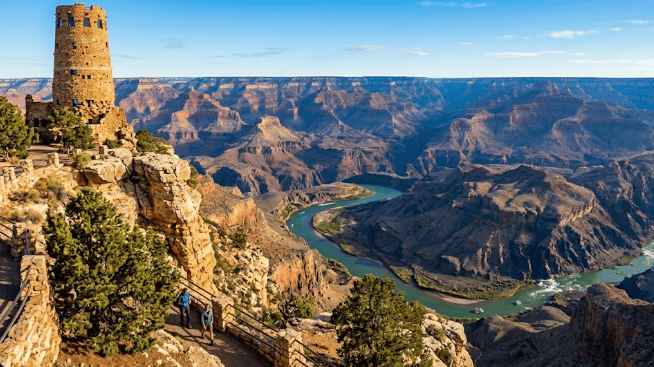
Desert View Watchtower, about 25 miles east of the main visitor center, combines canyon views with a historic 70-foot stone tower designed by architect Mary Colter, offering one of the more distinctive man-made landmarks within the park itself.
Hiking Trails
Rim Trail is the most accessible option in the entire park — a mostly flat, paved path running along the South Rim for about 13 miles total, though most visitors walk a manageable section rather than the full distance. Wheelchair accessible in sections, and genuinely suitable for nearly any fitness level since you can join or leave at multiple shuttle stops.
Bright Angel Trail is the most popular maintained trail descending into the canyon, with rest houses and seasonal water stations at 1.5 and 3 miles down, making it possible to hike a meaningful distance into the canyon and back without committing to a full descent. This is the trail most rangers recommend for visitors wanting an inner-canyon experience without extreme commitment — turn around at the 1.5 or 3-mile rest house rather than continuing further.
South Kaibab Trail offers more dramatic, exposed views than Bright Angel but has no water sources along its length, making it suitable only for well-prepared hikers doing shorter out-and-back sections rather than extended hikes, particularly outside the cooler months.
Note on the North Kaibab Trail: as of the most recent 2026 season information, this trail has experienced closures related to rockslide damage and required structural maintenance. If a North Rim inner-canyon hike is central to your trip plans, check current trail status directly through the park’s official conditions page before finalizing your itinerary.
Beyond Hiking
Colorado River rafting ranges from half-day smooth-water trips requiring no special permit (just booking through an authorized outfitter) to multi-day whitewater expeditions through the inner canyon, the longer commercial trips typically booked one to two years in advance given limited permit availability. Non-commercial rafting trips require winning a spot through the NPS’s weighted lottery system.
Helicopter and small plane tours depart from both the South Rim area and Las Vegas, offering an entirely different perspective on the canyon’s scale, particularly popular for visitors with limited time who still want to see deeper sections of the canyon inaccessible by road.
The Grand Canyon Skywalk, located at Grand Canyon West rather than the main National Park areas, offers a glass-bottomed horseshoe platform extending out over the canyon — a separate ticketed experience from standard park entrance, popular as a Las Vegas day trip given the shorter drive distance.
Sample Itineraries
The 1-Day South Rim Visit
Arrive early (before 9:30 a.m. if visiting during peak season to beat entrance line waits), start at Mather Point and the main visitor center, walk a comfortable section of the Rim Trail toward Yavapai Point, have lunch in the Grand Canyon Village area, then take the shuttle out to Hopi Point or Mohave Point for sunset. This covers the essential South Rim experience without any overnight commitment.
The 2-3 Day South Rim Deep Dive
Add a half-day hike on the Bright Angel Trail (turning around at the 1.5 or 3-mile rest house depending on fitness and season), a full exploration of Desert View Drive including the Watchtower, and unhurried time at multiple viewpoints for both sunrise and sunset, which look genuinely different depending on the time of day and weather. This is the recommended pace for visitors wanting to actually absorb the park rather than checking it off a list.
The Both-Rims Trip (5+ Days, May-October Only)
Given the substantial five-hour drive between rims, this only makes sense with a longer overall timeline. Spend 2-3 days on the South Rim, then make the drive to the North Rim for a noticeably quieter, higher-elevation experience with its own distinct viewpoints, including Bright Angel Point and Cape Royal. This itinerary only works when the North Rim is seasonally open, so confirm dates fall within the May 15 – October 15 window before planning around it.
Where to Stay
Inside the Park (South Rim): Lodges like El Tovar, Bright Angel Lodge, and Kachina Lodge offer the convenience of walking distance to major viewpoints, but these book out significantly in advance for peak season — six months or more isn’t unreasonable for summer dates.
Tusayan: The closest gateway town to the South Rim entrance, just a few miles south, offering a wider range of hotel options than the in-park lodges, generally at lower rates, with shuttle access into the park itself.
Williams, Arizona: About an hour from the South Rim, with notably more lodging variety and lower average rates than Tusayan, plus its own Route 66 heritage if you’re combining this trip with a Mother Road itinerary.
Camping: Mather Campground, the largest and most accessible option, sits about a mile from the canyon rim and offers 327 sites, bookable through Recreation.gov well in advance for peak season dates. For those wanting to sleep inside the canyon itself, Phantom Ranch at the bottom requires entering a separate lottery system through Recreation.gov given extremely limited capacity.
What to Pack
Layers, even in summer. The South Rim sits at roughly 7,000 feet elevation, and evening temperatures drop considerably even after a hot day — a detail that surprises visitors who only planned for daytime heat.
Sturdy hiking footwear if you’re doing any inner-canyon trail, not just rim walking. Loose gravel and steep switchbacks on trails like Bright Angel make casual sneakers a genuine liability beyond short rim-trail walks.
A wide-brimmed hat and high-SPF sunscreen. Sun exposure at this elevation, combined with minimal shade on most inner-canyon trails, is more intense than most visitors expect.
More water capacity than feels necessary. A simple guideline rangers commonly cite: roughly one liter per hour of inner-canyon hiking in warm conditions, which adds up faster than most day-pack capacities account for by default.
A headlamp or flashlight if you’re doing any hike timed around sunrise, since trailheads are often reached in pre-dawn darkness during the safer, cooler hiking windows.
Photography Tips
Sunrise and sunset transform the canyon completely. Midday light flattens the canyon’s color gradients into a relatively uniform tan-brown, while the low-angle light of early morning and evening brings out the dramatic reds, oranges, and purples the canyon is famous for in photographs. If you only have time for one optimized photo session, prioritize sunset over sunrise — most photographers find the evening light slightly more dramatic, and logistically it’s easier to plan around than a pre-dawn departure.
Hopi Point and Mohave Point are the established sunset spots for good reason — unobstructed westward views with minimal foreground obstruction. They also get crowded at peak season sunset times, so arriving 30-45 minutes early secures a good position.
A polarizing filter meaningfully cuts haze in canyon photography, particularly useful during summer months when afternoon humidity and dust can soften distant detail.
Don’t neglect the Desert View Watchtower as a photo subject in its own right — the structure itself, combined with canyon views from its upper levels, offers a different kind of shot than the more commonly photographed open viewpoints.
Wide-angle lenses help capture scale, but don’t skip telephoto shots entirely — compressed, zoomed shots of distant canyon layers and rock formations often convey the geological texture better than wide shots, which can sometimes flatten the sense of depth paradoxically.
What a Grand Canyon Trip Actually Costs
Entrance fees run $35 per vehicle for a week-long pass, a relatively minor trip expense regardless of trip length.
Lodging varies enormously by choice. In-park lodges like El Tovar run on the higher end given their location and historic status, while gateway towns like Williams offer noticeably more budget-friendly options, generally in the $100-180/night range for a standard hotel room during peak season, less in winter.
Guided activities add up quickly if you opt into them — helicopter tours typically range from $200-400+ per person, rafting day trips from $150-250 per person, and mule rides into the canyon (a classic but limited-availability option) often booked many months in advance at premium pricing.
A realistic budget for a 2-3 day South Rim trip for two people, mixing a mid-range hotel in Tusayan or Williams with self-guided hiking and viewpoint exploration (no helicopter tours or rafting), typically lands in the $600-1,000 range including fuel from a regional starting point, not counting flights.
Common Mistakes to Avoid
Underestimating the distance between rims. First-time visitors sometimes assume they can casually see both the South and North Rim in a single day trip, not realizing the five-hour drive between them. Plan around one rim per trip unless your timeline genuinely allows for the full crossing.
Attempting an ambitious inner-canyon hike without proper preparation. This bears repeating beyond the safety section above — rim-to-river hikes look deceptively manageable on a trail map, and the return climb in heat is where most serious incidents occur. Start with shorter out-and-back hikes to a rest house, not the canyon floor, especially on a first visit.
Visiting in peak summer without a plan for the heat. July and August bring both the largest crowds and the most dangerous inner-canyon temperatures of the year. If summer is your only available window, build your itinerary around early morning and evening activities, treating midday as rest time rather than hiking time.
Skipping advance lodging reservations. In-park lodges and even nearby gateway-town hotels fill up significantly ahead of peak season dates. Booking even a month out for summer travel often means settling for less convenient options than booking three to six months ahead.
Forgetting that cash isn’t accepted at entrance stations. As of recent seasons, Grand Canyon entrance stations only accept credit/debit cards and passes — bring a card, not assume cash will work as a backup payment method.
Combining Grand Canyon With Other Destinations
Given its location in northern Arizona, the Grand Canyon pairs naturally with several other major Western attractions. Sedona, about two hours south, offers a striking red-rock landscape and strong hiking scene that contrasts nicely with the canyon’s scale. Las Vegas, roughly four to four and a half hours from the South Rim (closer if visiting Grand Canyon West specifically), makes the canyon a viable add-on for travelers already planning a Nevada trip. And for those driving the historic Mother Road, the canyon sits close enough to the Arizona stretch of Route 66 that it’s one of the most commonly added detours on that entire route — see our Route 66 road trip guide for how this fits into a longer itinerary.
Getting There
By Car (South Rim): The South Rim is accessible via Highway 64 from Williams, Arizona, or via the East Entrance through Cameron. Phoenix Sky Harbor International Airport, about 3.5-4 hours south, is the most common major airport for South Rim visitors who are flying in, though smaller regional airports exist closer to the park.
By Car (North Rim): Reached via Highway 67 from Jacob Lake, Arizona, this approach only makes sense seasonally given the North Rim’s mid-May to mid-October operating window. The drive itself, through the Kaibab National Forest, is scenic enough to be worthwhile on its own.
By Train: The historic Grand Canyon Railway runs daily from Williams, Arizona, directly into the South Rim’s Grand Canyon Village, offering a genuinely different and notably relaxing way to arrive compared to driving, with the added bonus of not needing to deal with in-park parking, which can be limited during peak season.
By Air: Both Phoenix and Las Vegas serve as common gateway airports depending on which part of the canyon you’re visiting — Phoenix for the South Rim, Las Vegas if you’re primarily interested in Grand Canyon West and the Skywalk, given its significantly shorter drive from that airport.
Shuttle System Within the Park: Once you’re at the South Rim, a free, well-organized shuttle system covers Hermit Road (closed to private vehicles for most of the year), the Village area, and Kaibab Trail Route, meaning a car genuinely isn’t necessary for getting between viewpoints once you’ve arrived and parked.
Frequently Asked Questions
Can you see the Grand Canyon in one day? Yes, and a well-planned single day at the South Rim genuinely covers the park’s essential experience — major viewpoints, a rim walk, and sunset. It won’t include any meaningful inner-canyon hiking, but it’s a complete and satisfying visit on its own.
Is the Grand Canyon good for kids? The South Rim’s Rim Trail and viewpoint areas work well for families, with flat, accessible paths and shuttle access. The main caution is the lack of guardrails at most viewpoints — supervise children closely near any unmarked edge, and consider keeping younger kids to the more developed, fenced viewpoint areas rather than open rim sections.
How far down is it to hike to the bottom and back in one day? The National Park Service explicitly advises against this for any visitor, regardless of fitness level. Round trip distances run 16-21 miles depending on trail choice, with elevation changes exceeding what most day hikers anywhere else in the country have trained for, combined with the extreme inner-canyon heat covered in the safety section above.
Which rim should first-time visitors choose? The South Rim, in the large majority of cases. It has more infrastructure, year-round access, and the most iconic, widely recognized viewpoints. The North Rim is genuinely worth a visit for travelers with more time or those seeking a quieter experience, but it shouldn’t be the default choice for a first trip with limited days.
Do I need a permit to hike into the canyon? Day hikes on maintained trails like Bright Angel and South Kaibab require no permit. Overnight backcountry camping below the rim requires a backcountry permit, obtained either through advance lottery application or, in limited cases, as a last-minute walk-up at the Backcountry Information Centers.
Is the Grand Canyon Skywalk part of the National Park? No. The Skywalk is located at Grand Canyon West, operated by the Hualapai Tribe on tribal land roughly 120 miles from the South Rim, and requires separate tickets purchased through that operation rather than standard NPS entrance fees. It’s a distinct experience from the main national park, popular primarily as a shorter day trip from Las Vegas.
Can you bring pets to the Grand Canyon? Pets on leashes are permitted on the Rim Trail and in developed areas of both rims, but are not allowed below the rim on any inner-canyon trail, in park lodging (with limited exceptions), or on shuttle buses. Given how much of the inner-canyon experience defines a Grand Canyon trip for many visitors, this is a park better suited to leaving pets at home unless your visit is specifically rim-focused.
What’s the best month to avoid both crowds and extreme heat? October consistently comes up as the strongest single-month answer across most data sources — inner canyon temperatures have eased from summer extremes, South Rim crowds have thinned from peak summer levels, and North Rim fall colors add a seasonal bonus not available earlier in the year, all while the North Rim typically remains open through mid-month.
For families planning a longer Western trip, see our family-friendly USA national parks guide for tips on combining destinations like this with younger kids in mind.
A Bit of Geology and History
Understanding roughly what you’re looking at adds real depth to a Grand Canyon visit, even for travelers who don’t consider themselves science-minded.
The canyon’s exposed rock layers represent an almost unbroken geological record spanning nearly two billion years — among the most complete sequences of Earth’s history visible anywhere on the planet. The Colorado River began actively carving the canyon roughly five to six million years ago, a relatively short timeframe geologically speaking, cutting through layer after layer of rock that had been deposited over the preceding billions of years through ancient seas, deserts, and river systems.
The canyon has been inhabited and used by Indigenous peoples for thousands of years, and eleven tribes maintain traditional and cultural connections to the canyon today, including the Hualapai, Havasupai, Navajo, and Hopi nations, among others. The Havasupai Tribe maintains a reservation within the canyon itself, near the famous turquoise waterfalls of Havasu Canyon — a separate permit system and hiking destination from the main National Park areas, requiring its own advance reservations given extremely limited visitor capacity.
President Theodore Roosevelt, after visiting in 1903, became a strong advocate for the canyon’s protection, famously urging visitors of the era to “leave it as it is.” The area was designated a national monument in 1908 and became a national park in 1919, making it one of the older designated parks in the current system, predating the National Park Service’s full modern management structure by just a few years.
Final Thoughts
The Grand Canyon rewards both the rushed one-day visitor and the person who builds an entire week around it, which is part of what makes it such an enduring destination. A sunrise at Mather Point delivers real impact even on the tightest schedule, while a multi-day inner-canyon trip — done with appropriate respect for the heat and distance involved — offers an entirely different relationship with the landscape.
What separates a good Grand Canyon trip from a forgettable one usually comes down to two decisions made well before arrival: picking a season and rim that match what you actually want from the visit, and taking the inner-canyon heat guidance seriously rather than dismissing it as standard travel-blog caution that doesn’t apply to a reasonably fit traveler. The numbers on heat-related incidents are real, and they happen to capable hikers who simply underestimated how different the canyon floor’s climate is from the rim’s.
Do both of those things — sensible timing and genuine respect for the terrain — and this park delivers on every bit of its reputation as one of the most striking natural landscapes in the country, if not the world.