

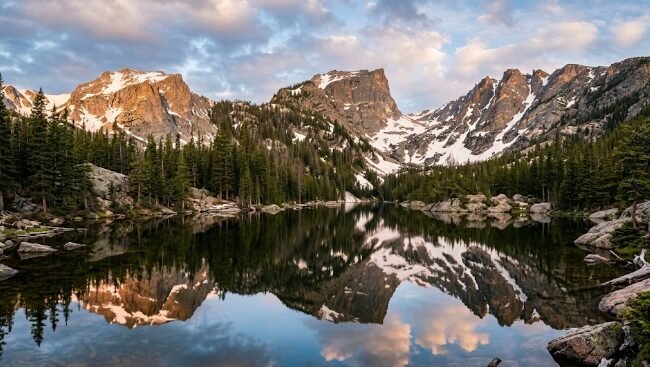
Rocky Mountain National Park runs the strictest, most detailed timed-entry permit system of any major U.S. national park in 2026 — and getting it wrong is the single most common way visitors lose an entire day of their trip. Get it right, though, and you’re rewarded with some of the most accessible high-alpine scenery in the country: Trail Ridge Road climbing above 12,000 feet, glacier-carved valleys, and consistently strong odds of spotting elk, moose, and bighorn sheep, often without leaving your car.
This guide walks through exactly how the 2026 permit system works, which areas need which permit, and how to build a trip that doesn’t get derailed by a missed reservation window. If you’re combining this with other Colorado or Western destinations, our USA road trip planning guide covers broader multi-state trip logistics.
Table of Contents
| Detail | Information |
|---|---|
| Entrance Fee | $35/vehicle (7-day), $30/motorcycle, $70 annual park pass |
| Timed Entry Required | May 22 – mid-October 2026 |
| Permit Processing Fee | $2 (non-refundable, separate from entrance fee) |
| Highest Point (Trail Ridge Road) | Over 12,000 feet |
| Nearest Gateway Town | Estes Park (east side), Grand Lake (west side) |
Understanding Rocky Mountain National Park’s 2026 Timed Entry System
This is the single most important section of this guide — read it carefully before booking anything else for your trip.
Rocky Mountain National Park requires a timed entry reservation from May 22 through mid-October 2026, but the system splits into two distinct permit types depending on which part of the park you’re visiting.
| Permit Type | Hours Required | Covers | Validity Dates |
|---|---|---|---|
| Timed Entry | 9 AM – 2 PM | All of RMNP except Bear Lake Road Corridor | May 22 – October 12, 2026 |
| Timed Entry + Bear Lake Road | 5 AM – 6 PM | Bear Lake Road Corridor plus the entire rest of the park | May 22 – October 18, 2026 |
Critical detail: a standard “Timed Entry” permit does NOT grant access to the Bear Lake Road Corridor — home to some of the park’s most popular trailheads, including Bear Lake, Dream Lake, and Alberta Falls. If those are on your list, you need the “+Bear Lake Road” permit specifically, and it sells out fastest given its broader access.
🎟️ Book Your Timed Entry Permit on Recreation.gov →
Permit Release Schedule for 2026
| Release Date (8 AM MDT) | Covers Entry Dates |
|---|---|
| May 1, 2026 | May 22 – June 30 |
| June 1, 2026 | July (+ unbooked June dates) |
| July 1, 2026 | August (+ unbooked July dates) |
| August 1, 2026 | September (+ unbooked August dates) |
| September 1, 2026 | October 1–18 (+ unbooked September dates) |
Additional next-day releases: leftover permits release on a first-come, first-served basis at 7 PM MDT the night before your desired entry date. These sell out quickly but offer a genuine backup option for less-planned trips.
When You DON’T Need a Timed Entry Permit
- Entering the park outside the restricted hours (before 5 AM or after 2 PM/6 PM depending on the area)
- Holding a valid campground reservation (your camping confirmation serves as your entry permit)
- Booking through an authorized guiding service (jeep tours, fly fishing, photography tours, etc.)
- Using the free Hiker Shuttle from Estes Park
Important: a timed entry reservation is per vehicle, not per person, and does NOT replace your park entrance fee — you need both. Park passes can’t be purchased online alongside your timed entry reservation; bring a card to pay at the entrance station or one of the park’s automated fee machines.
Entrance Fees and Passes for 2026
| Pass Type | Price |
|---|---|
| 7-Day Vehicle Pass | $35 |
| 7-Day Motorcycle Pass | $30 |
| RMNP Annual Pass | $70 |
| America the Beautiful Annual Pass (US residents) | $80 |
| America the Beautiful Annual Pass (non-residents) | $250 |
As with several other major national parks, Rocky Mountain now charges a $100 nonresident surcharge for international visitors aged 16 and older, layered on top of standard entrance fees — unless they’re holding the $250 Non-Resident Annual Pass, which absorbs this surcharge. Non-U.S. residents still must pay entrance fees even on designated fee-free days, an exception to the standard fee-free policy that catches some international visitors off guard.
The Two Sides of the Park: Bear Lake Road vs. Everything Else
| Area | Permit Needed | Best For |
|---|---|---|
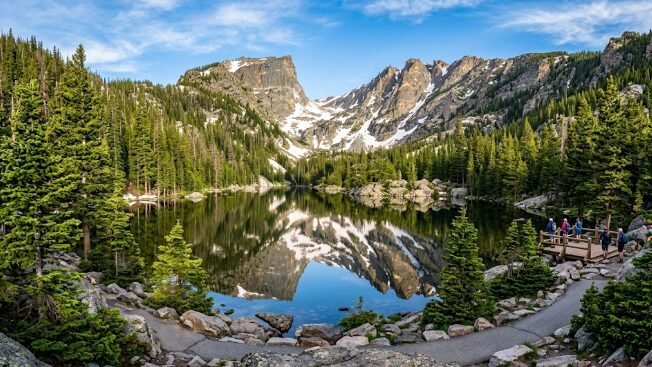
| Bear Lake Road Corridor | Timed Entry + Bear Lake Road | Bear Lake, Dream Lake, Alberta Falls, Emerald Lake hikes |
| Trail Ridge Road | Standard Timed Entry | Highest paved road in the U.S. national park system, Alpine Visitor Center |
| Wild Basin | Standard Timed Entry | Quieter hiking, waterfalls, fewer crowds |
| Grand Lake / West Side | Standard Timed Entry | Less crowded, access from the western entrance |
| Lily Lake | Standard Timed Entry | Easy, flat, family-friendly short walk |
Strategic tip: if your priority is the famous Bear Lake hikes, book the “+Bear Lake Road” permit early given how fast it sells. If you’re more interested in Trail Ridge Road’s high-elevation drive or Wild Basin’s quieter trails, the standard Timed Entry permit is easier to secure and genuinely sufficient.
Top Things to Do and See
Trail Ridge Road
The highest continuous paved road in the entire National Park System, climbing above 12,000 feet and crossing the Continental Divide. The Alpine Visitor Center, perched near the road’s high point, offers genuinely sweeping views and a realistic chance to see elk or bighorn sheep grazing right alongside the parking area. The road is seasonal — typically open late May through mid-October, weather permitting, so it’s worth checking current status before planning a trip specifically around this drive.
Bear Lake and the Glacier Gorge Trails
Bear Lake itself offers a flat, accessible half-mile loop reflecting the surrounding peaks — one of the most rewarding short walks in the entire park. From the same trailhead, longer hikes to Dream Lake, Emerald Lake, and Alberta Falls extend the visit for hikers wanting more distance, all departing from the same heavily trafficked but genuinely worthwhile corridor.
Wild Basin
A quieter alternative on the park’s southeast side, Wild Basin offers waterfall hikes and noticeably thinner crowds than Bear Lake, while still falling under the simpler, easier-to-book standard Timed Entry permit.
Wildlife Viewing
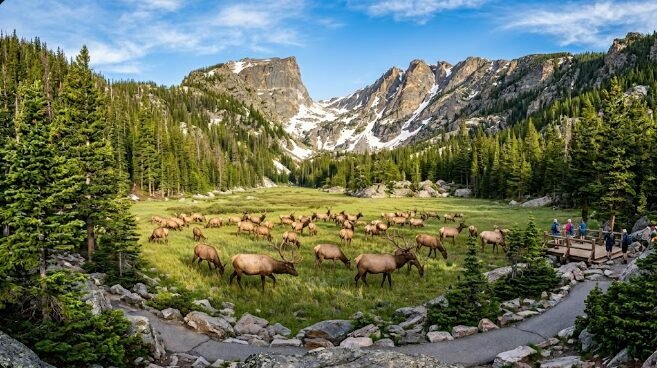
Rocky Mountain National Park offers consistently strong wildlife viewing, particularly elk, which gather in large herds in meadows near Estes Park and throughout the park during the September-October rut, when bull elk bugling becomes a genuine highlight for visitors timing their trip around it. Moose are regularly spotted in the Kawuneeche Valley on the park’s west side, and bighorn sheep frequent Sheep Lakes near the Fall River Entrance, especially in early summer.
🦌 Book a Guided Wildlife or Photography Tour →
Sample Itineraries
The 1-Day Bear Lake Focus
Book the “+Bear Lake Road” permit for your earliest available window. Hike Bear Lake’s easy loop, continue to Dream Lake or Emerald Lake if time and fitness allow, finish with a drive partway up Trail Ridge Road for sunset views.
The 2-Day Full Park Experience
Day one: standard Timed Entry permit for Trail Ridge Road and the Alpine Visitor Center, with a stop at Wild Basin for a quieter waterfall hike. Day two: “+Bear Lake Road” permit for the park’s most famous trail corridor, arriving as early as your permit window allows.
Combining With Other Colorado Destinations
Estes Park and Rocky Mountain National Park pair naturally with a broader Colorado road trip — Denver sits roughly 90 minutes away, and the drive itself offers strong mountain scenery worth building into a longer itinerary if your schedule allows.
Where to Stay
| Base Town | Side of Park | Best For |
|---|---|---|
| Estes Park | East side | Most lodging, dining, direct access to Bear Lake Road |
| Grand Lake | West side | Quieter, smaller, less crowded |
🏨 Compare Estes Park Hotels & Cabins →
Camping: Aspenglen, Glacier Basin, and Timber Creek campgrounds all operate within the park, bookable through Recreation.gov. A confirmed camping reservation doubles as your timed entry permit, with check-in beginning at 1 PM on your first reserved day.
Best Time to Visit Rocky Mountain National Park
June: Wildflowers bloom and Trail Ridge Road typically reaches full opening by mid-to-late June, though some years see a slightly later opening depending on snowpack. Crowds are building but haven’t hit peak summer levels.
July-August: Peak season, with the heaviest crowds and the highest demand for both timed entry permits and lodging. Full road and trail access, warm (though still cool at elevation) temperatures.
September: Widely considered the best window for visitors with flexibility — the elk rut brings dramatic wildlife activity, crowds thin from summer peaks, and timed entry permits become somewhat easier to secure, particularly outside weekends.
October: The timed entry system winds down (October 12 for standard, October 18 for Bear Lake Road), fall colors peak in aspen groves, and conditions become more weather-dependent as the season turns toward winter.
Winter (November-April): No timed entry system required, dramatically thinner crowds, but Trail Ridge Road closes completely above the snow line, limiting access to lower-elevation areas only.
What to Pack
Layers for genuine alpine conditions. Trail Ridge Road’s elevation means temperatures can be 20-30°F cooler than Estes Park on the same day, with sudden weather shifts — including summer snow — a real possibility at the highest elevations.
Sun protection appropriate for high elevation. UV exposure increases significantly above 10,000 feet, and visitors consistently underestimate how much stronger the sun feels at Trail Ridge Road’s elevation compared to lower-altitude hiking.
A printed copy of your timed entry confirmation, in addition to having it on your phone — cell service can be unreliable at higher elevations and entrance stations, and a backup avoids any confusion at the gate.
Common Mistakes to Avoid
Booking the wrong permit type for your planned activities. This is the single most common and most disappointing mistake — arriving with a standard Timed Entry permit only to discover it doesn’t cover Bear Lake Road, where your planned hike actually starts.
Waiting too long to book. Given the monthly release schedule and genuine demand, popular dates — especially weekends in July, August, and the September rut — sell out within hours of release, not days.
Assuming the timed entry reservation includes your entrance fee. These are two separate purchases, and arriving with only one means being turned away or facing an unexpected charge at the gate.
Not having a backup plan if your preferred permit type is sold out. A standard Timed Entry permit still grants access to genuinely worthwhile areas like Trail Ridge Road and Wild Basin — don’t assume a trip is ruined just because Bear Lake Road specifically is unavailable for your dates.
How Rocky Mountain Compares to Other Parks With Reservation Systems
2026 has brought a genuinely mixed landscape of park access rules, and Rocky Mountain National Park sits at the strictest end of that spectrum. Unlike Yosemite and Glacier National Park, both of which dropped their reservation systems entirely for 2026, Rocky Mountain has maintained — and arguably refined — its dual-permit structure. Meanwhile, Zion National Park takes a different approach entirely, requiring a permit only for the specific Angels Landing trail rather than general park entry. Understanding which model applies to wherever you’re headed next prevents the kind of last-minute confusion that ruins a trip’s first day.
Frequently Asked Questions
Do I need a timed entry reservation to visit Rocky Mountain National Park in 2026? Yes, from May 22 through mid-October, during specific hours depending on which permit type and area you’re visiting. Outside this window or these hours, no reservation is required, though a standard entrance fee always applies.
What’s the difference between the two permit types? “Timed Entry” (9 AM–2 PM) covers most of the park but excludes the Bear Lake Road Corridor. “Timed Entry + Bear Lake Road” (5 AM–6 PM) covers everything, including Bear Lake Road, and is required if Bear Lake, Dream Lake, or Alberta Falls are on your itinerary.
How much does a timed entry reservation cost? Just a $2 non-refundable Recreation.gov processing fee, separate from your standard park entrance fee ($35/vehicle for 7 days).
Can I buy a timed entry permit at the park entrance? No — these must be purchased online in advance through Recreation.gov. They are not available in person at entrance stations or visitor centers.
What if I don’t have a timed entry reservation and arrive during restricted hours? You will be turned away at the entrance. Exceptions apply only for campground reservation holders, guided tour participants, and Hiker Shuttle users — there is no walk-up or pay-at-the-gate option during restricted hours.
Final Thoughts
Rocky Mountain National Park’s 2026 permit system rewards exactly the kind of advance planning this guide is built around — know which permit type matches your actual itinerary, book the moment your travel dates’ release window opens, and keep a backup plan ready in case your first-choice permit sells out. Do that groundwork, and the park delivers some of the most accessible high-alpine scenery in the entire National Park System, from Trail Ridge Road’s sweeping views to Bear Lake’s postcard-perfect reflection, all within a few hours of Denver.